






Stocks ignore bond market warnings

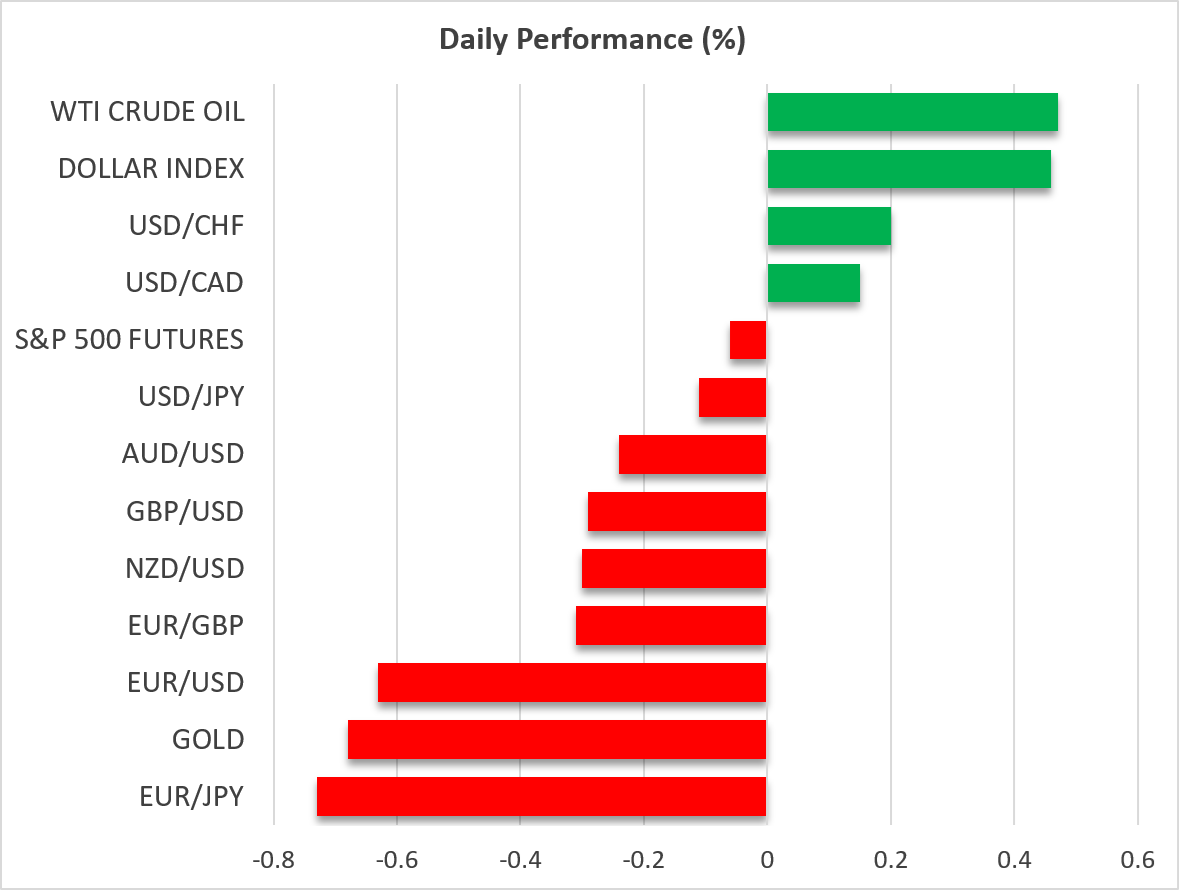
Equities appear to ignore other markets
Following a mixed September, with only the Nasdaq 100 index posting solid gains among the major stock indices, US equities have been powering ahead at the start of October. Both the Nasdaq 100 and the broader S&P 500 indices posted fresh all-time highs yesterday, with utilities and energy stocks leading the rally in the latter.
Equity investors are apparently ignoring the price action in other assets, such as bond yields and oil prices, painting a rather bright picture for the short-term outlook, mostly due to the AI hype. However, historically, the bond market tends to be a better indicator of the economic outlook than stocks.
Bond yield and oil prices send a different message
Bond yields have been climbing on the back of higher inflation expectations, a rising term premium and an evident loss of demand, thus tightening financial conditions and potentially limiting the need for aggressive rate hikes by major central banks. The 10-year US Treasury yield is trading at 5.31%, at the time of writing, 55bps above the end-August level. Notably, after a strong 3-year auction, $39bn of the current 10-year Treasury benchmark will be offered today, ahead of tomorrow’s challenging 30-year bond auction.
At the same time, the decline in WTI oil prices appears to have paused, amidst fresh attacks by Houthi rebels on Saudi Arabia and a strong chance of bad weather shutting down refineries in the US Gulf region. Meanwhile, there is still no light at the end of the tunnel for the US-Iran talks, with a strong possibility of the current stalemate persisting until the US midterm elections.
The US dollar remains in demand
Despite the soft start to the week, the US dollar is holding its gains across the FX spectrum, benefiting from the current mixed risk appetite, after an impressive September. Euro/dollar is hovering around 1.1225, at the time of writing, as Fedspeak has evidently become less hawkish after last week’s soft data releases.
An October Fed rate hike is out of the picture at the moment, although that could reverse if next week's CPI, PPI and retail sales reports post significant upside surprises. Interestingly, the minutes from the September 16 Fed meeting will be released later today (18:00 GMT), with investors monitoring likely divergences in the FOMC to adjust their rate hike bets for 2026, but mostly for the first half of 2027.
Euro’s troubles persist
Similar to Fed expectations, the market has been pricing out ECB rate hikes. From being treated as a certainty in mid-September, the chances of a December ECB rate hike have dropped to 84% despite persistently hawkish comments from ECB officials. The euro’s main problem, though, is the political developments, bringing back memories of the 2009-2018 period.
The eurozone appears to be headless at a crucial time, as German Chancellor Merz remains under pressure to resign, Spain will hold a snap election in late November, and there is public unrest in France, with President Macron being unable to turn the situation around. As a result, French bond yields have been rising, with investors even pondering the idea of the ECB, via its TPI programme, buying French debt.
Steady gold; bitcoin edges lower
Finally, the $4,134 area continues to act as a floor, restricting bearish pressure, as gold’s path higher remains obstructed by dollar strength and rising real yields. A relaxation of both factors could open the door to a rally, although there are some key resistance areas ahead that could quickly limit bullish reactions. Meanwhile, bitcoin is edging lower today, gradually forming an unconfirmed double top pattern that could push the king of cryptocurrencies back below the $80k level.


Gold Edges Higher as Dollar Weakens Ahead of US Midterm Results

Gold/Silver & Gold/Platinum Ratios: Deconstructing the Metals Sell-Off Divergence

GBPUSD Edges Towards 1.3463 as Traders Brace for the Bank of England Decision

Weak NZ Jobs Data Keeps NZDUSD Under Pressure

Gold buying by central banks has hit its highest rate since 2024.

Daily Technical Analysis: Gold Reclaims $3,900 After Hitting Its Lowest Level Since October 2025

Daily Fundamental Analysis: Wall Street Starts November on a Cautious Note Ahead of US Midterm Elections