-1162026812.png)
-1162026812.png)





US 10-Year Yields at 5%: Are Markets Approaching a Tipping Point?

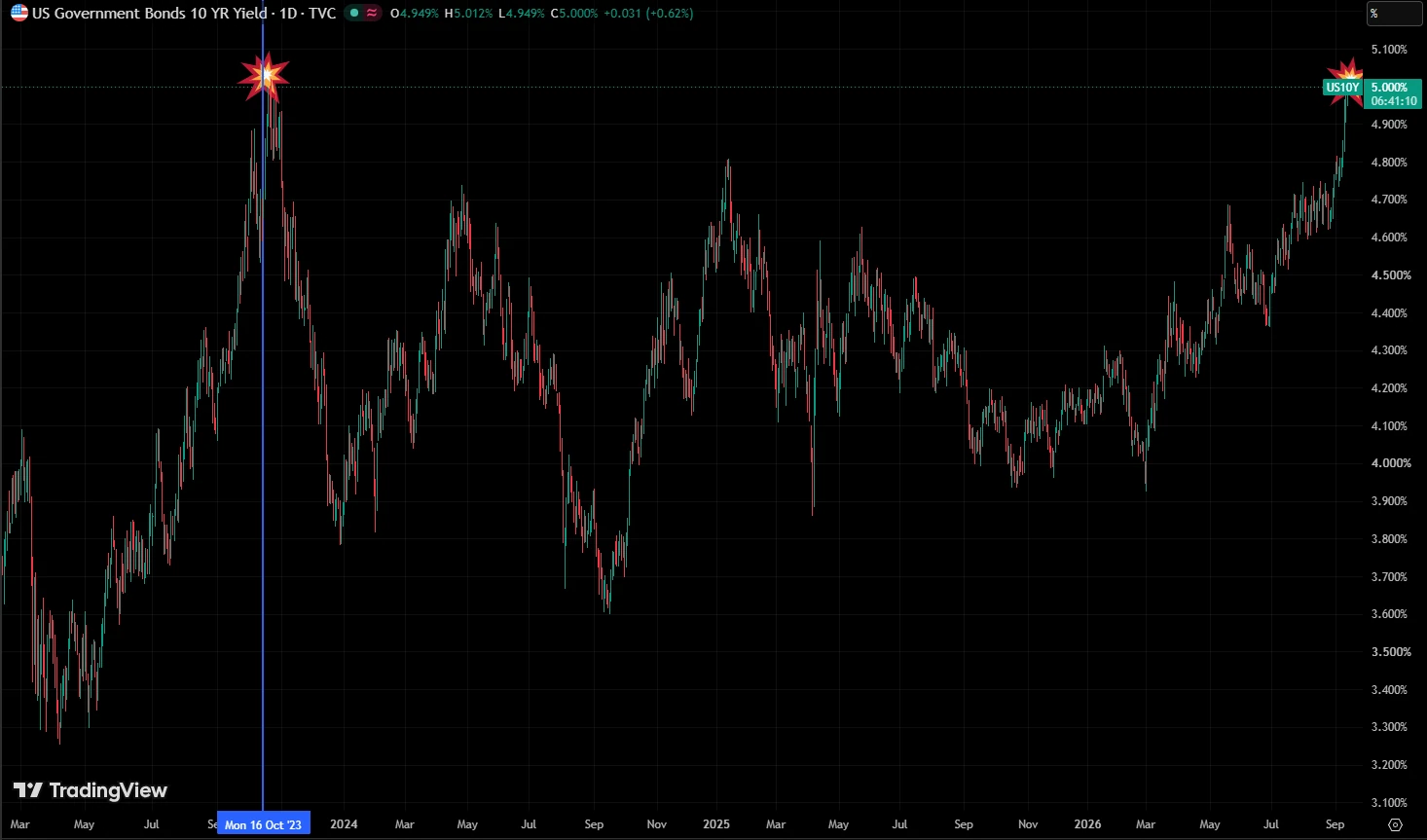
Almost three years later, we are back at the same level.
The yield on the 10-year US Treasury has reached the psychologically significant 5% threshold, amid a broader sell-off across Western sovereign bond markets.
The question is whether this is simply another repricing of rates — or the beginning of something more consequential.
One possible scenario is a form of ‘perfect storm’: bonds fall, yields rise, equities come under pressure, while commodities remain comparatively resilient. Higher energy prices would add another layer of inflationary pressure, potentially reinforcing the rise in long-term yields.
For now, however, the situation is not critical.
The 5% level is primarily psychological. What matters is whether yields remain above it, how quickly borrowing costs rise from here, and whether policymakers eventually feel compelled to intervene.
That brings Yield Curve Control (YCC) back into the discussion. If pressure at the long end of the curve becomes systemic, measures designed to contain borrowing costs could become increasingly relevant. Timely intervention could make conditions appear relatively orderly on the surface — although higher energy and fuel costs would remain an uncomfortable consequence.
The ‘point of no return’There is also a deeper issue: the sustainability of US government debt.
Economist Joachim Klement has warned that the United States could eventually reach a position in which it must borrow simply to meet the interest payments on its existing debt.
This creates the risk of a self-reinforcing cycle:
higher debt → higher interest expense → greater borrowing requirements → higher servicing costs → still more debt.
That would represent a much more serious tipping point than the 5% Treasury yield itself.
If breaking this cycle ultimately requires higher taxation and cuts to government benefits, the consequences would extend beyond financial markets. Fiscal consolidation could create considerable economic and political pressure, further undermining already fragile public confidence in government.
So, 5% is not a crisis in itself.
It is, however, a useful measure of how rapidly the price of money is changing for an economy carrying an exceptionally large debt burden.
The real question is not whether the 10-year Treasury has reached 5%.It is what happens after 5%.Trade smart with Headway


Gold buying by central banks has hit its highest rate since 2024.

Daily Technical Analysis: Gold Reclaims $3,900 After Hitting Its Lowest Level Since October 2025

Daily Fundamental Analysis: Wall Street Starts November on a Cautious Note Ahead of US Midterm Elections

Bitcoin tests key support as election uncertainty and tech sell-off weigh

Will gold climb back above $4,000?

Crypto turns gloomy

US midterm elections in the spotlight as stock market rout persists