-1162026812.png)
-1162026812.png)





OIL NEARS $117: COULD PRICES REACH $130 BEFORE THE END OF THE YEAR?

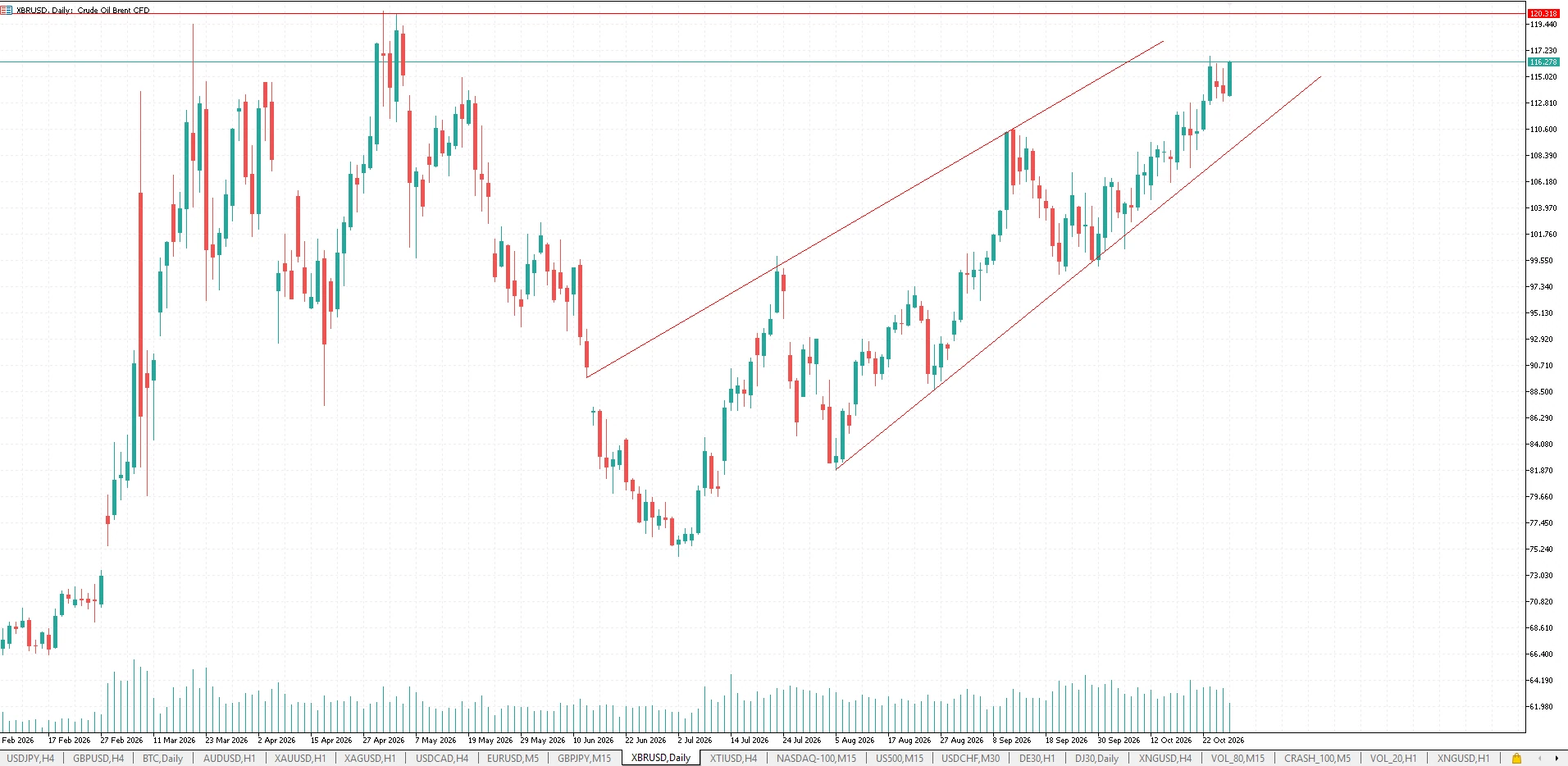
The key level to watch for oil is $116.775, October's high. If prices break convincingly above this level and hold there on the daily chart, the next obvious target would be the psychological $120 mark. A further escalation in the Middle East could then push oil towards $125–130, particularly if traders start pricing in the possibility of serious disruption to shipments through the Strait of Hormuz. Record US oil production should help ease some of the pressure on supply, but it may not be enough to make up for a significant loss of Middle Eastern exports.
There is, of course, another possibility. If oil fails to break above $116.775 and tensions in the Middle East begin to ease, we could see traders taking profits after the recent rally. The first area to watch on the downside would be $112–110, followed by $105 and the psychologically important $100 level if selling gathers pace. These are potential price targets rather than firmly established support levels, so much will depend on how the market behaves as it approaches them.
The political backdrop could be particularly important over the coming weeks. With the US midterm elections taking place on 3 November, petrol and diesel prices will be firmly in the political spotlight. The Trump administration therefore has every reason to want greater stability in energy markets. At the same time, the risk of a fresh confrontation with Iran remains, including possible attacks on oil facilities or disruption to major shipping routes. Developments in Israel could also influence whether the region moves towards a diplomatic settlement or further escalation. If military pressure takes precedence over negotiations, oil could make another run at $120–130. If meaningful progress is made towards an agreement and shipping through the Strait of Hormuz returns to normal, some of the geopolitical risk premium could quickly disappear from prices.
Looking ahead to the end of 2026, the big question is whether supply concerns will continue to outweigh the damage that high energy prices are doing to the global economy. Expensive oil is good news for producers, but it also pushes up inflation, raises transport costs and puts further pressure on businesses and consumers, particularly in Europe and Asia. If supply disruptions continue, a move towards $125–130 remains entirely possible. On the other hand, a sustained easing of tensions could bring prices back towards $105–100. The US Energy Information Administration expects American oil production to reach a record annual average in 2026, although uncertainty over Middle Eastern supplies is likely to keep the market volatile.
My view is that oil is approaching a crucial point. With prices hovering around $116, just below resistance at $116.775, the next significant move could be sharp in either direction. Ultimately, what happens in Washington, Tehran and across the wider Middle East is likely to matter far more than any technical indicator.Trade smart with Headway


Gold is holding on to $4,000

The Fed will set the course for the markets
EBC Markets Briefing | Wall St stunned by Brazil's status quo vote

Stocks and dollar climb ahead of Fed, kiwi sinks on RBNZ shock

Crypto recovers as Fed decision looms

Dollar Firms and Oil Rebounds Ahead of Fed Decision

FOMC Today, ECB Tomorrow — Will GOLD Break Above $4,160 or Fall Below $3,950?